'%20stroke='none'%3e%3cpath%20d='M%20761%2039%20L%20760%2062%20L%20912%20216%20L%201003%20329%20L%201071%20463%20L%201112%20603%20L%201132%20608%20L%201149%20582%20L%201165%20516%20L%201163%20403%20L%201145%20330%20L%201088%20216%20L%201017%20132%20L%20918%2062%20L%20821%2034%20Z'/%3e%3cpath%20d='M%201429%20756%20L%201409%20755%20L%201383%20772%20L%201233%20919%20L%201123%201002%20L%201003%201064%20L%20862%201111%20L%20852%201131%20L%20925%201156%20L%201044%201155%20L%201142%201131%20L%201246%201080%20L%201313%201029%20L%201395%20932%20L%201432%20834%20Z'/%3e%3cpath%20d='M%20219%20262%20L%20223%20282%20L%20251%20290%20L%20481%20262%20L%20625%20265%20L%20737%20289%20L%20852%20332%20L%20878%20326%20L%20869%20291%20L%20841%20255%20L%20757%20187%20L%20658%20144%20L%20550%20125%20L%20440%20130%20L%20361%20154%20L%20254%20218%20Z'/%3e%3cpath%20d='M%201283%20295%20L%201246%20293%20L%201230%20312%20L%201226%20499%20L%201208%20632%20L%201174%20743%20L%201091%20894%20L%201087%20930%20L%201148%20912%20L%201237%20836%20L%201292%20760%20L%201335%20660%20L%201355%20554%20L%201351%20440%20L%201329%20358%20L%201311%20322%20Z'/%3e%3cpath%20d='M%20518%201092%20L%20526%201128%20L%20551%201167%20L%20633%201247%20L%20724%201300%20L%20821%201333%20L%20906%201345%20L%201023%201337%20L%201100%201306%20L%201152%201259%20L%201147%201240%20L%201118%201230%20L%20913%201217%20L%20782%201194%20L%20655%201151%20L%20545%201092%20Z'/%3e%3cpath%20d='M%20534%20340%20L%20477%20325%20L%20368%20337%20L%20284%20370%20L%20191%20433%20L%20123%20504%20L%2073%20591%20L%2051%20667%20L%2057%20762%20L%2076%20764%20L%20115%20731%20L%20221%20592%20L%20305%20504%20L%20416%20422%20L%20537%20354%20Z'/%3e%3cpath%20d='M%20279%20649%20L%20220%20704%20L%20178%20781%20L%20149%20884%20L%20144%201001%20L%20158%201085%20L%20189%201158%20L%20246%201235%20L%20304%201279%20L%20317%201269%20L%20319%201234%20L%20271%20953%20L%20272%20823%20L%20297%20675%20L%20294%20651%20Z'/%3e%3cpath%20d='M%20340%20984%20L%20329%201040%20L%20349%201141%20L%20392%201232%20L%20447%201305%20L%20519%201372%20L%20613%201424%20L%20715%201441%20L%20759%201431%20L%20757%201407%20L%20727%201375%20L%20578%201256%20L%20502%201183%20L%20441%201111%20L%20362%20993%20Z'/%3e%3c/g%3e%3c/svg%3e)
Lunar Phases
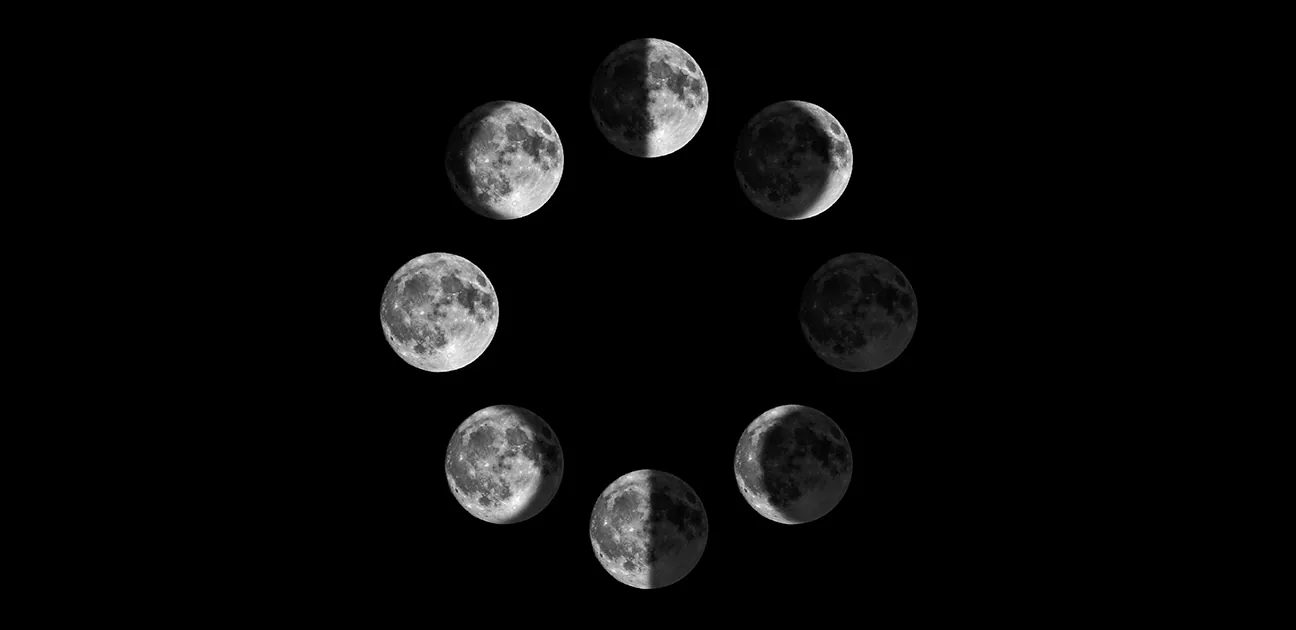
An overview of the phases of our Moon.
The Moon has been our closest celestial companion for billions of years. Its changing appearance in the night sky — from thin crescents to bright full moons — has inspired calendars, festivals, and myths across human history. Yet the mechanics behind these phases are elegantly simple.
🌙 Why Does the Moon Have Phases?
The Moon doesn’t produce light; it reflects sunlight. As the Moon orbits Earth, we see different portions of its sunlit half, depending on the geometry between the Sun, the Earth (our viewpoint), and the Moon itself. Even though the Moon always shows the same face toward Earth due to tidal locking, the illuminated fraction changes continuously over roughly 29.53 days — the duration of a synodic month.
In essence, the phase we see is determined by the angle between the Sun and the Earth as viewed from the Moon. This shifting geometry creates the gradual transition we observe from thin crescents to full illumination.
🌗 The Eight Classic Phases
During a full lunar cycle, the Moon transitions through eight commonly recognized stages. These include the New Moon, where the Moon lies between Earth and the Sun and appears completely dark; the Waxing Crescent, when a thin arc of sunlight begins to appear on the right; the First Quarter, in which half of the lunar face becomes illuminated; and the Waxing Gibbous phase, where the bright region grows larger.
At the midpoint lies the Full Moon, when the Earth is positioned between the Sun and the Moon and the entire near side reflects sunlight. After this, the cycle reverses: the Waning Gibbous phase brings a gradual shrink in brightness, followed by the Last Quarter, where the left half is illuminated, and finally the Waning Crescent, the final thin arc before returning to the New Moon.
Although these phases are given distinct names, the transition between them is entirely continuous. The simulation allows you to see this smooth progression with complete clarity.
🛰️ How the Simulation Works
This 3D visualization is designed to show the Moon’s phases exactly as we experience them from Earth. The model uses high-resolution NASA lunar textures that reveal mountains, maria, and craters with realistic shading and depth.
📡 Sources
High-resolution lunar textures and scientific data used in this simulation are provided by NASA’s Scientific Visualization Studio and the USGS Astrogeology Science Center.